 Vibe Arc
Case study · Our own tool
The tool I built to run my own method.
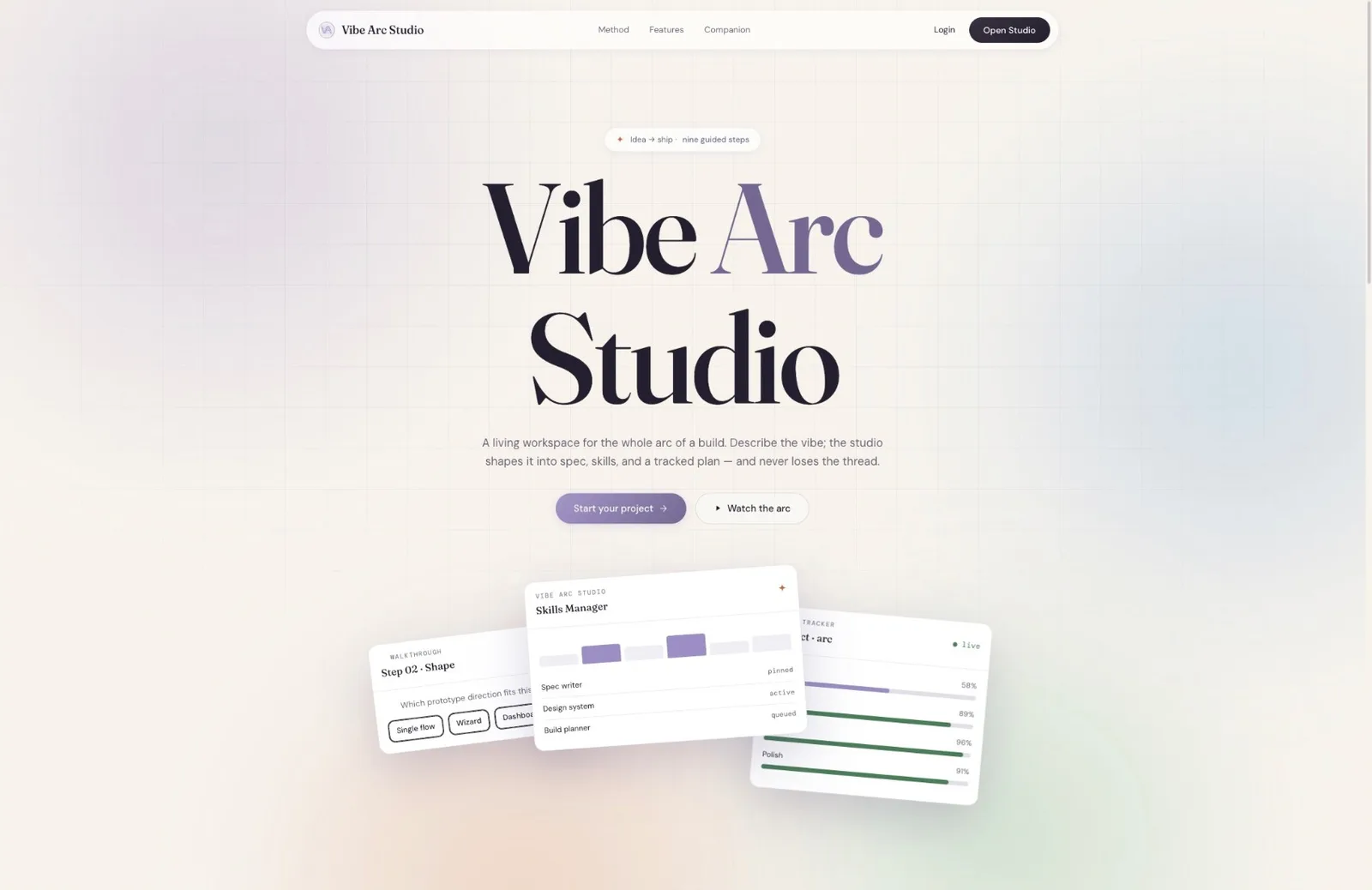
Turning an idea into a buildable spec used to take me hours across several tools. Studio does it in about ten minutes, and it was built with the same method it teaches.
- Role
- Product, spec and build
- Timeline
- June to September 2026
- Built with
- Lovable, Supabase, Claude, GPT, Gemini
- Status
- v1.6, in active use
01 · Discovery
The problem
My workflow lived in Claude. One assistant sharpened the idea into a prompt, another wrote the brief, then a separate project session produced the spec documents, and only then the build tracker.
It worked, but it was slow and inconsistent. Context disappeared between sessions, the information I needed took too long to find, and the whole process was tied to a single model.
02 · Blueprint
Specified with its own method
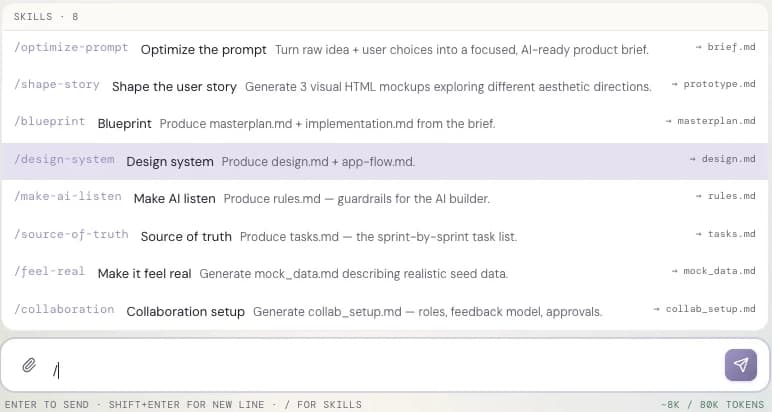
Before any code, Studio got the same documents it now produces for others: a masterplan, an implementation plan, a design system, an app flow and a task list.
Ten decisions were locked up front, and the out of scope list was written as carefully as the feature list. If the method could not structure its creator's own product, it could not structure anyone else's.
- Speed from AI, judgment from us
- Every file becomes context
- One project, one context bubble
03 · Build
Two ways through
The hardest part was not the code, it was the flow: making nine steps feel simple and fast. The answer was two paths. A guided walkthrough asks for what it needs and moves you forward, or you work in chat and call each step as a skill.
Either way, every file is saved at its stage and feeds the next one. At the end you download everything, generate a build tracker, or hand the files to Lovable or Claude Code.
04 · What broke
Four problems, and how I fixed them
The build tracker drifted.
The first version asked the AI to write the whole tracker page. Colors drifted, logic broke, and each run cost over 12,000 tokens.
The fix: Now I ship a tested template and the AI fills in only the data: about 1,500 tokens, and it cannot break the layout.
Deleted projects came back to life.
Cloud sync saw a project online but not on the device, and restored it within a second.
The fix: Sync now remembers deletions, and deleting goes through Archive first, so nothing is lost by accident.
API keys lived in the browser.
That is fine for a prototype and wrong for anything real.
The fix: Every model call now goes through the server, so keys never reach the page.
The plan changed, on purpose.
The spec said local only. Real use across a laptop and a phone said otherwise.
The fix: Studio got accounts and sync, including conflict handling and offline mode.
Don't ask AI to build infrastructure it can't see being tested.
05 · Result
Where it stands today
- ~10 min
- from a raw idea to a full spec set
- ~10
- documents per project, all editable
- 3 to 4
- real projects so far
- 4
- AI providers in one workspace
Projects that went through it include a license manager for BLK Architects and the Peak app.
Studio is still in development, and I am its main user. I have shown it to several people and the interest is clear, so opening it to paying users is next on the table.